| Sources |
- [S1046] Wikipedia: Boudica, (Name: Wikipedia;), Boudica.
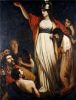
Boudica or Boudicca (/ˈbuːdɪkə, boʊˈdɪkə/, from Brythonic *boudi victory, win + *-ka having suffix, i.e. 'Victorious Woman', known in Latin chronicles as Boadicea or Boudicea, and in Welsh as Buddug (Welsh pronunciation: [bɨðɨɡ])), was a queen of the ancient British Iceni tribe, who led a failed uprising against the conquering forces of the Roman Empire in AD 60 or 61. She is considered a British national heroine and a symbol of the struggle for justice and independence.
Boudica's husband Prasutagus, with whom she had two daughters, ruled as a nominally independent ally of Rome. He left his kingdom jointly to his daughters and to the Roman emperor in his will. When he died, his will was ignored, and the kingdom was annexed and his property taken. According to the Roman historian Tacitus, Boudica was flogged and her daughters raped. The historian Cassius Dio wrote that previous imperial donations to influential Britons were confiscated and the Roman financier and philosopher Seneca called in the loans he had forced on the reluctant Britons.
In 60/61, Boudica led the Iceni and other British tribes in revolt. They destroyed Camulodunum (modern Colchester), earlier the capital of the Trinovantes, but at that time a colonia for discharged Roman soldiers. Upon hearing of the revolt, the Roman governor Gaius Suetonius Paulinus hurried from the island of Mona (modern Anglesey) to Londinium, the 20-year-old commercial settlement that was the rebels' next target. Unable to defend the settlement, he evacuated and abandoned it. Boudica's army defeated a detachment of the Legio IX Hispana, and burnt both Londinium and Verulamium. In all, an estimated 70,000–80,000 Romans and Britons were killed by Boudica's followers. Suetonius, meanwhile, regrouped his forces, possibly in the West Midlands, and despite being heavily outnumbered, he decisively defeated the Britons. Boudica died, by suicide or illness, shortly afterwards. The crisis of 60/61 caused Nero to consider withdrawing all his imperial forces from Britain, but Suetonius's victory over Boudica confirmed Roman control of the province.
Interest in these events was revived in the English Renaissance and led to Boudica's fame in the Victorian era and as a cultural symbol in Britain.
https://en.wikipedia.org/wiki/Boudica
- [S1047] Wikipedia: Prasutagus, (Name: Wikipedia;), Prasutagus.
Prasutagus (died AD 60 or 61) was king of a British Celtic tribe called the Iceni, who inhabited roughly what is now Norfolk, in the 1st century AD. He is best known as the husband of Boudica.
Prasutagus may have been one of the eleven kings who surrendered to Claudius following the Roman conquest in 43,[1] or he may have been installed as king following the defeat of a rebellion of the Iceni in 47.[2] As an ally of Rome his tribe were allowed to remain nominally independent, and to ensure this Prasutagus named the Roman emperor as co-heir to his kingdom, along with his two daughters. Tacitus says he lived a long and prosperous life, but when he died, the Romans ignored his will and took over, depriving the nobles of their lands and plundering the kingdom. Boudica was flogged and her daughters raped.[3] Roman financiers called in their loans.[4] All this led to the revolt of the Iceni, under the leadership of Boudica, in 60 or 61.
Coins have been found in Suffolk inscribed SVB ESVPRASTO ESICO FECIT, "under Esuprastus Esico made (this)" in Latin. Some archaeologists believe that Esuprastus was the true name of the king Tacitus calls Prasutagus, while others think he was a different person. Others interpret Esuprastus is a compound name, with "Esu-" deriving from the god Esus and meaning "lord", "master" or "honour", and "Prasto-" being an abbreviated personal name, the coin inscription thus meaning "under Lord Prasto-". It is also notable that coins of the Corieltauvi have been found inscribed with the similar names IISVPRASV and ESVPASV. The name of an earlier king of the Iceni appears on coins as SCAVO, a name which may be related to the Latin scaeva, "left", and scaevola, "left-handed". Both rulers' coins are similarly Roman in style and language and were probably issued within twenty years of each other. Chris Rudd suggests that Esuprastus, whom he identifies with Prasutagus, succeeded Scavo after the Icenian rebellion of 47
https://en.wikipedia.org/wiki/Prasutagus
|

 Female
 Female