| Sources |
- [S6040] FindAGrave Old World.
- [S320] Wikipedia: Charlemagne, Emperor Charlemagne.
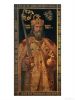
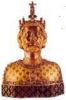
Charlemagne (2 April 748 – 28 January 814) was King of the Franks from 768, King of the Lombards from 774, and Emperor of the Carolingian Empire from 800, all until his death in 814. Charlemagne succeeded in uniting the majority of Western Central Europe, and he was the first recognized emperor to rule in the west after the fall of the Western Roman Empire approximately three centuries earlier. Charlemagne's rule saw a program of political and societal changes that had a lasting impact on Europe in the Middle Ages.
A member of the Frankish Carolingian dynasty, Charlemagne was the eldest son of Pepin the Short and Bertrada of Laon. With his brother Carloman I, he became king of the Franks in 768 following Pepins's death, and became sole ruler in 771. As king, he continued his father's policy towards the protection of the papacy and became its chief defender, removing the Lombards from power in northern Italy in 774. Charlemagne's reign saw a period of expansion that led to the conquests of Bavaria, Saxony, and northern Spain, as well as other campaigns that led Charlemagne to extend his rule over a vast area of Europe. He spread Christianity to his new conquests, often by force, as seen at the Massacre of Verden against the Saxons.
In 800, Charlemagne was crowned as emperor in Rome by Pope Leo III. While historians debate about the exact significance of the coronation, the title represented the height of prestige and authority he had achieved. Charlemagne's position as the first emperor in the West in over 300 years brought him into conflict with the contemporary Eastern Roman Empire based in Constantinople. By his assumption of the imperial title, he is considered the forerunner of the line of Holy Roman Emperors that lasted into the nineteenth century. As king and emperor, Charlemagne engaged in a number of reforms in administration, law, education, military organization, and religion which shaped Europe for centuries. The stability of his reign saw the beginning of a period of significant cultural activity known as the Carolingian Renaissance.
Charlemagne died in 814, and was laid to rest in the Aachen Cathedral, in his imperial capital city of Aachen. He was succeeded by his only surviving son Louis the Pious. After Louis, the Frankish kingdom would be divided, eventually coalescing into West and East Francia, which would respectively become France and the Holy Roman Empire. Charlemagne's profound impact on the Middle Ages, and the influence on the vast territory he ruled has led him to be called the "Father of Europe". He is seen as a founding figure by multiple European states, and many historical royal houses of Europe trace their lineage back to him. Charlemagne has been the subject of artwork, monuments, and literature since the medieval period, and has received veneration in the Catholic Church.
https://en.wikipedia.org/wiki/Charlemagne
- [S457] Wikipedia: Bertrada of Laon, Bertrade de Laon II.
Bertrada of Laon (born between 710 and 727 – 12 July 783), also known as Bertrada the Younger or Bertha Broadfoot (cf. Latin: Regina pede aucae i.e. the queen with the goose-foot), was a Frankish queen. She was the wife of Pepin the Short and the mother of Charlemagne, Carloman and Gisela.
Bertrada's nickname "Bertha Broadfoot" dates back to the 13th century, when it was used in Adenes Le Roi's trouvère Li rouman de Berte aus grands piés.[1] The exact reason that Bertrada was given this nickname is unclear. It is possible that Bertrada was born with a clubfoot,[2] although Adenes does not mention this in his poem.[1] The nickname might have been a reference to an ancient legend about a Germanic goddess named Perchta, to real and mythological queens named Bertha, or to several similarly-named Christian queens.[3] Many myths and legends exist in Europe and Asia, in which clubfooted people are described as the link between the world of the living and the spirit world.[4] The tavern sign in Anatole France's novel At the Sign of the Reine Pédauque alludes to this queen.
https://en.wikipedia.org/wiki/Bertrada_of_Laon
- [S458] Wikipedia: Pepin the Short, Pepin Martel III.
Pepin the Short[a] (German: Pippin der Kurze, French: Pépin le Bref, c. 714 – 24 September 768) was the King of the Franks from 751 until his death. He was the first of the Carolingians to become king.[b][2]
The younger son of the Frankish prince Charles Martel and his wife Rotrude, Pepin's upbringing was distinguished by the ecclesiastical education he had received from the monks of St. Denis. Succeeding his father as the Mayor of the Palace in 741, Pepin reigned over Francia jointly with his elder brother Carloman. Pepin ruled in Neustria, Burgundy, and Provence, while his brother Carloman established himself in Austrasia, Alemannia and Thuringia. The brothers were active in suppressing revolts led by the Bavarians, Aquitanians, Saxons, and the Alemanni in the early years of their reign. In 743, they ended the Frankish interregnum by choosing Childeric III, who was to be the last Merovingian monarch, as figurehead king of the Franks.
https://en.wikipedia.org/wiki/Pepin_the_Short
- [S339] Wikipedia: Hildegard of the Vinzgau, Hildegard de Vinzgau.
Hildegard (ca. 754[1] – 30 April 783 at Thionville,[2] Moselle), was the second[3] wife of Charlemagne and mother of Louis the Pious. Little is known about her life, because, like all women of Charlemagne, she became important only from a political background, recording her parentage, wedding, death, and her role as a mother.
She was the daughter of the Germanic Count Gerold of Kraichgau (founder of the Udalriching family) and his wife Emma, in turn daughter of Duke Nebe (Hnabi) of Alemannia and Hereswintha vom Bodensee (of Lake Constance).[5] Hildegard's father had extensive possessions in the dominion of Charlemagne's younger brother Carloman, so this union was of significant importance for Charlemagne, because he could strengthen its position in the east of the Rhine and also could bind the Alemannian nobility to his side.
https://en.wikipedia.org/wiki/Hildegard_of_the_Vinzgau
- [S1060] Wikipedia: Gersuinda, Gerswinda de Saxony.
Gersuinda (also Gersvinda, Gervinda; died after 800). Gersuinda was a concubine of the emperor Charlemagne, with whom he was in a relationship after the death of his last legitimate wife, Luitgard (died June 4, 800). According to Charlemagne's contemporary biographer, Einhard, Gersuinda was a Saxon, a people whom Charlemagne subdued over a thirty year period.
https://en.wikipedia.org/wiki/Gersuinda
- [S324] Wikipedia: Desiderata of the Lombards, Desiderata of the Lombards.
Desiderata, or Ermengarda[1], was one of four daughters of Desiderius, king of the Lombards, and his queen, Ansa. She was married to Charlemagne, king of the Franks, in 770, probably to form a bond between the otherwise enemy states of Francia and The Kingdom of the Lombards. The marriage was annulled in 771 and this hurt relations with the Lombards, presaging the war of 774. She had no known children and after the marriage was annulled she retired to the Monastery of Santa Giulia in Brescia.
Although she is commonly referred to by the name Desiderata, it is now theorised that the name derives from an editorial error in a 19th-century copy of the Monumenta Germaniae Historica which capitalised the d in desideratam filiam (Latin for desired daughter). Even this error was sometimes compounded by a back formation to Desideria, a more probable first name (the feminine form of Desiderius, her father's name), or translated (as into French, Désirée).
The noted Carolingian historian Janet Nelson hypothesised in the 1998 work After Rome's Fall that Desiderius' daughter was in fact named Gerperga. The reasoning used by Nelson hinges on the confusion that many contemporaries apparently had between her and Gerberga, the Frankish wife of Carloman, who was brother of Charlemagne and his co-ruler from 768 to 771. Even Pope Stephen III seems to confuse the two and the chroniclers and annalists seem to believe that Gerberga fled, when her husband died, to the court of her father (she fled to Desiderius, who was definitely not her father). What is definite is that Desiderius and Ansa had three other daughters named Anselperga, Adelperga, and Liutperga. The commonality in the names of their daughters is the ending "-perga". Based on this, the author believes the confusion was caused because the two queens (wives of the two brothers Charles and Carloman) had the same name, namely Gerberga or Gerperga, which are, respectively, the Frankish and Lombard versions of the modern French name Gerberge
https://en.wikipedia.org/wiki/Desiderata_of_the_Lombards
- [S338] Wikipedia: Himiltrude, Himiltrude.
Little is known about Himiltrude's origins. Paulus Diaconus calls her a "noble girl".[1] The appearance of her name in the fraternity books of Alemannian monasteries may suggest an affiliation with the Germanic Alemannian or Alsatian nobility,[2] while other sources make her the daughter of a Burgundian count and a granddaughter of Grimbert I, Count of Paris. It is not possible, however, to extrapolate any political ramifications from Charlemagne's relationship with Himiltrude.[1]
Himiltrude probably entered into a relationship with Charlemagne during the lifetime of his father, Pepin the Younger.[1] When Charlemagne acceded to the throne in 768, Himiltrude remained unnamed in official sources – contrary to the example set by Charlemagne's mother, Bertrada of Laon.[1] Himiltrude bore Charles a son called Pépin. Shortly after Pepin's birth, an alliance was formulated between Charlemagne and the King of the Lombards, Desiderius. To seal the alliance, it was agreed that Charlemagne should marry Desiderius' daughter (called Desiderata by modern scholars).
Himiltrude was dismissed at that time and disappears from historical records. A grave excavated in the monastery of Nivelles was found to contain the corpse of a forty-year-old woman, possibly identifiable with Himiltrude. If so, Himiltrude would appear to have died long after 770, although if and when she retired to Nivelles cannot be deduced.[1]
Her son Pépin, who suffered from a spinal deformity and was called "the Hunchback", was eclipsed by Charlemagne's sons from his later marriage to Hildegard. Following an attempted rebellion against his father, Pepin was confined to a monastery.
The nature of Himiltrude's relationship to Charlemagne is a matter of dispute. Charlemagne's biographer Einhard calls her a "concubine"[3] and Paulus Diaconus speaks of Pippin's birth "before legal marriage",[1] whereas a letter by Pope Stephen III refers to Charlemagne and his brother Carloman as being already married (to Himiltrude and Gerberga), and advises them not to dismiss their wives.[1]
Historians have interpreted the information in different ways. Some, such as Pierre Riché, follow Einhard in describing Himiltrude as a concubine.[4] Others, Dieter Hägemann for example, consider Himiltrude a wife in the full sense.[2] Still others subscribe to the idea that the relationship between the two was "something more than concubinage, less than marriage" and describe it as a Friedelehe, a supposed form of marriage unrecognized by the Church and easily dissolvable. This form of relationship is often seen in a conflict between Christian marriage and more flexible Germanic concepts.
https://en.wikipedia.org/wiki/Himiltrude
- [S331] Wikipedia: Fastrada, Fastrada.
Fastrada (765 – 10 August 794) was queen consort of East Francia by marriage to Charlemagne, as his third wife.
Fastrada was born circa 765 at Ingelheim, the daughter of the powerful East Frankish Count Rudolph (also called Eadolf), and his wife, Aeda.
Fastrada became the third wife of Charlemagne,[1] marrying him in October 783 at Worms, Germany, a few months after Queen Hildegard’s death. A probable reason behind the marriage was to solidify a Frankish alliance east of the Rhine when Charles was still fighting the Saxons.
Due to her influence, Charlemagne's son by Himiltrude, Pepin the Hunchback, was publicly tonsured after an attempted rebellion against his father. During their marriage, Charlemagne's fair ruling greatly declined. She was greatly despised by all of the other children.
https://en.wikipedia.org/wiki/Fastrada
|


 742 - 814 (71 years)
 [1, 2]