| Sources |
- [S6040] FindAGrave Old World, Louis I “the Pious” of the Franks 778-840.
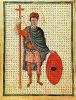
Emperor Louis I (Holy Roman Empire), called The Pious (778-840), Holy Roman emperor (814-840), king of France (814-840), king of Germany (814-840), and king of Aquitaine (781-840). He was the son and sole successor of Charlemagne. In 817 Louis made plans for an orderly succession among his sons: Lothair I, Louis II (Louis the German), and Pepin of Aquitaine. Later he wanted to include in the succession Charles II (Charles the Bald), his son by a second marriage. Dissatisfied, his older sons rebelled (830, 833) against him and fought among themselves for supremacy as well. Pepin died in 838, and in 843 the empire was divided among the three surviving brothers.
https://www.findagrave.com/memorial/84022206/louis_i-of_the_franks
- [S54] Ancestry Family Trees, (Name: Online publication - Provo, UT : Ancestry.com. Original data: Family Tree files submitted by Ancestry members.;), Database online.
Record for Ermengarde DeHesbaye
- [S929] Wikipedia: Louis the Pious, Louis Carolingian I.
Louis the Pious (778 – 20 June 840), also called the Fair, and the Debonaire,[1] was the King of the Franks and co-Emperor (as Louis I) with his father, Charlemagne, from 813. He was also King of Aquitaine from 781.
As the only surviving adult son of Charlemagne and Hildegard, he became the sole ruler of the Franks after his father's death in 814, a position which he held until his death, save for the period 833–34, during which he was deposed.
During his reign in Aquitaine, Louis was charged with the defence of the empire's southwestern frontier. He conquered Barcelona from the Muslims in 801 and asserted Frankish authority over Pamplona and the Basques south of the Pyrenees in 812. As emperor he included his adult sons, Lothair, Pepin, and Louis, in the government and sought to establish a suitable division of the realm among them. The first decade of his reign was characterised by several tragedies and embarrassments, notably the brutal treatment of his nephew Bernard of Italy, for which Louis atoned in a public act of self-debasement.
In the 830s his empire was torn by civil war between his sons, only exacerbated by Louis's attempts to include his son Charles by his second wife in the succession plans. Though his reign ended on a high note, with order largely restored to his empire, it was followed by three years of civil war. Louis is generally compared unfavourably to his father, though the problems he faced were of a distinctly different sort.
https://en.wikipedia.org/wiki/Louis_the_Pious
- [S339] Wikipedia: Hildegard of the Vinzgau, Hildegard de Vinzgau.
Hildegard (ca. 754[1] – 30 April 783 at Thionville,[2] Moselle), was the second[3] wife of Charlemagne and mother of Louis the Pious. Little is known about her life, because, like all women of Charlemagne, she became important only from a political background, recording her parentage, wedding, death, and her role as a mother.
She was the daughter of the Germanic Count Gerold of Kraichgau (founder of the Udalriching family) and his wife Emma, in turn daughter of Duke Nebe (Hnabi) of Alemannia and Hereswintha vom Bodensee (of Lake Constance).[5] Hildegard's father had extensive possessions in the dominion of Charlemagne's younger brother Carloman, so this union was of significant importance for Charlemagne, because he could strengthen its position in the east of the Rhine and also could bind the Alemannian nobility to his side.
https://en.wikipedia.org/wiki/Hildegard_of_the_Vinzgau
- [S320] Wikipedia: Charlemagne, Emperor Charlemagne.
Charlemagne (2 April 748 – 28 January 814) was King of the Franks from 768, King of the Lombards from 774, and Emperor of the Carolingian Empire from 800, all until his death in 814. Charlemagne succeeded in uniting the majority of Western Central Europe, and he was the first recognized emperor to rule in the west after the fall of the Western Roman Empire approximately three centuries earlier. Charlemagne's rule saw a program of political and societal changes that had a lasting impact on Europe in the Middle Ages.
A member of the Frankish Carolingian dynasty, Charlemagne was the eldest son of Pepin the Short and Bertrada of Laon. With his brother Carloman I, he became king of the Franks in 768 following Pepins's death, and became sole ruler in 771. As king, he continued his father's policy towards the protection of the papacy and became its chief defender, removing the Lombards from power in northern Italy in 774. Charlemagne's reign saw a period of expansion that led to the conquests of Bavaria, Saxony, and northern Spain, as well as other campaigns that led Charlemagne to extend his rule over a vast area of Europe. He spread Christianity to his new conquests, often by force, as seen at the Massacre of Verden against the Saxons.
In 800, Charlemagne was crowned as emperor in Rome by Pope Leo III. While historians debate about the exact significance of the coronation, the title represented the height of prestige and authority he had achieved. Charlemagne's position as the first emperor in the West in over 300 years brought him into conflict with the contemporary Eastern Roman Empire based in Constantinople. By his assumption of the imperial title, he is considered the forerunner of the line of Holy Roman Emperors that lasted into the nineteenth century. As king and emperor, Charlemagne engaged in a number of reforms in administration, law, education, military organization, and religion which shaped Europe for centuries. The stability of his reign saw the beginning of a period of significant cultural activity known as the Carolingian Renaissance.
Charlemagne died in 814, and was laid to rest in the Aachen Cathedral, in his imperial capital city of Aachen. He was succeeded by his only surviving son Louis the Pious. After Louis, the Frankish kingdom would be divided, eventually coalescing into West and East Francia, which would respectively become France and the Holy Roman Empire. Charlemagne's profound impact on the Middle Ages, and the influence on the vast territory he ruled has led him to be called the "Father of Europe". He is seen as a founding figure by multiple European states, and many historical royal houses of Europe trace their lineage back to him. Charlemagne has been the subject of artwork, monuments, and literature since the medieval period, and has received veneration in the Catholic Church.
https://en.wikipedia.org/wiki/Charlemagne
|


 778 - 840 (62 years)
 [1, 2, 3]