| Sources |
- [S54] Ancestry Family Trees, (Name: Online publication - Provo, UT : Ancestry.com. Original data: Family Tree files submitted by Ancestry members.;), Database online.
Record for Henry Tudor
http://search.ancestry.com/cgi-bin/sse.dll?db=pubmembertrees&h=-573509427&indiv=try
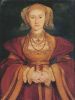
- [S10709] FindAGrave Old World (Famous), Anne of Cleves 1515-1557 - Queen Consort of England.
English Royal Consort. She was the fourth wife of English King Henry VIII and Queen of England from January 6, 1540, to July 9, 1540. Their marriage was strictly political, and there never was any romantic affection between them.
She was born "Anna von Kleve" in Dusseldorf of present-day Germany, the second daughter of John III of the House of La Marek, Duke of Cleves, and his wife Maria, Duchess of Julich-Berg. She was raised in Schlossburg on the edge of Solingen, in present-day Germany. In 1527, she was unofficially betrothed to Francis, the son and heir of the Duke of Lorraine, but it was cancelled in 1535.
After the death of Henry's third wife, Jane Seymour, in 1537, Henry began searching for a new wife. Her father became an ally to King Henry VIII following the Truce of Nice and the King's Chancellor, Thomas Cromwell, urged a match between her and the King. The artist Hans Holbein the Younger was sent to paint accurate portraits of her and her younger sister, so that Henry could choose between them. Negotiations began in March 1539, with Cromwell overseeing the discussions.
A marriage arrangement was signed on October 4 of that year to give Anne to Henry as his new wife, sight unseen. She lacked education and cultural sophistication which Henry valued. She had no formal education, but was skilled in needlework and liked playing card games. She could read and write only in German, but was considered gentle, virtuous, and docile, qualities that made her a suitable candidate for Henry.
In late 1539, she traveled to England, and Henry first met her at Rochester. Henry was immediately disappointed with her appearance and the reality that she was ill-suited to life at his court of art and music. He referred to her in an unflattering way as the "Flanders Mare" and urged Cromwell to find a legal way to avoid the marriage, but it was impossible without compromising the vital alliance England had with the Germans.
Despite Henry's misgivings, they were married on January 6, 1540, at the Royal Palace of Placentia in Greenwich, London, England, by Archbishop Thomas Crammer, and she converted to the Anglican faith. Their marriage was never consummated, and she was commanded to leave the Court on June 24th of that year. On July 6, she was advised of Henry's decision to reconsider the marriage. She was asked to consent to an annulment of their marriage on the grounds of non-consummation, to which she agreed. It became official on July 9, 1540. Henry gave her a generous settlement, including Richmond Palace and Hever Castle (the former home of Anne Boleyn's family), as well as an annual income.
They remained good friends and she was often invited to his Court. She also became an honorary member of his family and he gave her the title "The King's Beloved Sister." After Henry's death, she converted back to Catholicism, as the new English monarch, Queen Mary I, was a strict Catholic. When her health started failing, Mary allowed her to reside at Old Chelsea Manor, where Henry's last wife, Catherine Parr, had lived after her remarriage.
She died there, six weeks before her 42nd birthday, and was interred at Westminster Abbey, the only one of Henry VIII's wives to be buried there. She holds the distinction of being the last of Henry VIII's six wives to die.
https://www.findagrave.com/memorial/1967/an
- [S909] Wikipedia: Henry VIII, (Name: Wikipedia;), Wives of Henry VIII.
In common parlance, the wives of Henry VIII were the six queen consorts of King Henry VIII of England between 1509 and his death in 1547. In legal terms, Henry had only three wives, because three of his marriages were annulled by the Church of England. However, he was never granted an annulment by the Pope, as he desired, for Catherine of Aragon, his first wife. Annulments declare that a true marriage never took place, unlike a divorce, in which a married couple end their union. Along with his six wives, Henry took several mistresses.
https://en.wikipedia.org/wiki/Wives_of_Henry_VIII
- [S909] Wikipedia: Henry VIII, (Name: Wikipedia;), Henry VIII.
Henry VIII (28 June 1491 – 28 January 1547) was King of England from 22 April 1509 until his death in 1547. Henry is best known for his six marriages, and for his efforts to have his first marriage (to Catherine of Aragon) annulled. His disagreement with Pope Clement VII about such an annulment led Henry to initiate the English Reformation, separating the Church of England from papal authority. He appointed himself Supreme Head of the Church of England and dissolved convents and monasteries, for which he was excommunicated by the pope. Henry is also known as the "father of the Royal Navy" as he invested heavily in the English fleet, establishing a standing navy which he expanded from seven to some fifty ships over his lifetime, and developed its command structure.[1]
Domestically, Henry is known for his radical changes to the English Constitution, ushering in the theory of the divine right of kings in opposition to papal supremacy. He also greatly expanded royal power during his reign. He frequently used charges of treason and heresy to quell dissent, and those accused were often executed without a formal trial by means of bills of attainder. He achieved many of his political aims through the work of his chief ministers, some of whom were banished or executed when they fell out of his favour. Thomas Wolsey, Thomas More, Thomas Cromwell, and Thomas Cranmer all figured prominently in his administration.
Henry was an extravagant spender, using the proceeds from the dissolution of the monasteries and acts of the Reformation Parliament. He also converted the money that was formerly paid to Rome into royal revenue. Despite the money from these sources, he was continually on the verge of financial ruin due to his personal extravagance as well as multiple costly and largely unproductive wars, particularly with King Francis I of France, Holy Roman Emperor Charles V, King James V of Scotland and the Scottish regency under the Earl of Arran and Mary of Guise. At home, he oversaw the annexure of Wales to England with the Laws in Wales Acts 1535 and 1542 and was the first English monarch to rule as King of Ireland following the Crown of Ireland Act 1542.
Henry's contemporaries considered him to be an attractive, educated and accomplished king. He has been described as "one of the most charismatic rulers to sit on the English throne" and his reign has been described as the "most important" in English history.[2][3] He was an author and composer. As he aged, he became severely overweight and his health suffered. He is frequently characterised in his later life as a lustful, egotistical, paranoid and tyrannical monarch.[4] He was succeeded by his son Edward VI.
https://en.wikipedia.org/wiki/Henry_VIII
|

 1515 - 1557 (41 years)
 [1, 2]