| Sources |
- [S54] Ancestry Family Trees, (Name: Online publication - Provo, UT : Ancestry.com. Original data: Family Tree files submitted by Ancestry members.;), Database online.
Record for King of England Edward Plantagenet
http://search.ancestry.com/cgi-bin/sse.dll?db=pubmembertrees&h=42010149423&indiv=try
- [S1393] Wikipedia: Princes in the Tower, (Name: Wikipedia;), Princes in the Tower.
The Princes in the Tower refers to the apparent murder in England in the 1480s of the deposed King Edward V of England and Richard of Shrewsbury, Duke of York. These two brothers were the only sons of King Edward IV and Elizabeth Woodville surviving at the time of their father's death in 1483. When they were 12 and 9 years old, respectively, they were lodged in the Tower of London by their paternal uncle and all-powerful regent the Duke of Gloucester. This was supposedly in preparation for Edward V's forthcoming coronation. However, before the young king could be crowned, he and his brother were declared illegitimate. Gloucester ascended the throne as Richard III.[1]
It is unclear what happened to the boys after the last recorded sighting of them in the tower. It is generally assumed that they were murdered; a common hypothesis is that they were killed by Richard in an attempt to secure his hold on the throne. Their deaths may have occurred sometime in 1483, but apart from their disappearance, the only evidence is circumstantial. As a result, several other hypotheses about their fates have been proposed, including the suggestion that they were murdered by their maternal uncle the Duke of Buckingham or future brother-in-law King Henry VII, among others. It has also been suggested that one or both princes may have escaped assassination. In 1487, Lambert Simnel initially claimed to be the Duke of York, but later claimed to be York's cousin the Earl of Warwick. From 1491 until his capture in 1497, Perkin Warbeck claimed to be the Duke of York, having supposedly escaped to Flanders. Warbeck's claim was supported by some contemporaries, including York's aunt the Duchess of Burgundy.
In 1674, workmen at the tower dug up, from under the staircase, a wooden box containing two small human skeletons. The bones were widely accepted at the time as those of the princes, but this has not been proven and is far from certain. King Charles II had the bones buried in Westminster Abbey, where they remain
https://en.wikipedia.org/wiki/Princes_in_the_Tower
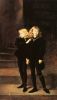 |
War-Execution of Princes in the Tower (Roses)
The Princes in the Tower refers to the apparent murder in England in the 1480s of the deposed King Edward V of England and Richard of Shrewsbury, Duke of York. These two brothers were the only sons of King Edward IV and Elizabeth Woodville surviving at the time of their father's death in 1483. When they were 12 and 9 years old, respectively, they… |
- [S10710] FindaGrave Old World (Youth/Famous), Richard Plantagenet - Duke of York 1473-1483.
British Royalty. Born at Dominican Friary, Shrewsbury, Shropshire, England the second son of Edward IV and Elizabeth Woodville. He was also known as Richard of Shrewsbury. He was created 1st Duke of York on May 28, 1474. He was invested as a Knight, Order of the Bath on April 18, 1475. He was invested as a Knight, Order of the Garter on May 15, 1475. He was betrothed to Anne, Baroness Mowbray on January 15, 1478. After his father the king died, he and his siblings were declared illigitamate by Parliament. He and his brother Edward were installed in royal apartments in the Tower, from where they disappeared and were presumed murdered sometime after 1485, victims of the War of the Roses. He and Edward are romantically remembered as 'The Princes in the Tower'.
https://www.findagrave.com/memorial/11774702/richard_plantagenet
- [S1392] Wikipedia: Edward V, (Name: Wikipedia;), Edward V of England.
Edward V (2 November 1470 – c. mid-1483) was de jure King of England from 9 April to 25 June 1483. He succeeded his father, Edward IV, upon the latter's death. Edward V was never crowned, and his brief reign was dominated by the influence of his uncle and Lord Protector, the Duke of Gloucester, who deposed him to reign as King Richard III; this was confirmed by the Act entitled Titulus Regius, which denounced any further claims through his father's heirs.
Edward V and his younger brother Richard of Shrewsbury, Duke of York, were the Princes in the Tower who disappeared after being sent to heavily guarded royal lodgings in the Tower of London. Responsibility for their deaths is widely attributed to Richard III, but the lack of solid evidence and conflicting contemporary accounts allow for other possibilities.
https://en.wikipedia.org/wiki/Edward_V_of_England
- [S8719] FindAGrave Old World - Memorial, Princes in the Tower.
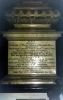
"Here lie interred the remains of Edward V King of England, and Richard, Duke of York, whose long desired and much sought after bones, after above an hundred and ninety years, were found by most certain tokens, deep interred under the rubbish of the stairs that led up to the Chapel of the White Tower, on the 17th of July in the year of our Lord 1674. Charles the second, a most merciful prince, having compassion upon their hard fortune, performed the funeral rites of these most unhappy princes among the tombs of their ancestors, anno domini 1678" Burial: Westminster Abbey Westminster Greater London, England Find A Grave Memorial# 2248
http://www.findagrave.com/cgi-bin/fg.cgi?page=gr&GRid=2248
- [S969] Wikipedia: Elizabeth Woodville, (Name: Wikipedia;), Elizabeth Woodville.
Elizabeth Woodville (also spelt Wydville, Wydeville, or Widvile;[nb 1] c. 1437[1] – 8 June 1492), later known as Dame Elizabeth Grey, was Queen of England from her marriage to King Edward IV on 1 May 1464 until Edward was deposed on 3 October 1470, and again from Edward's resumption of the throne on 11 April 1471 until his death on 9 April 1483.
At the time of her birth, Elizabeth's family was of middle rank in the English social hierarchy. Her mother, Jacquetta of Luxembourg, had previously been an aunt-by-marriage to Henry VI. Elizabeth's first marriage was to a minor supporter of the House of Lancaster, Sir John Grey of Groby. He died at the Second Battle of St Albans, leaving Elizabeth a widowed mother of two sons.
Elizabeth's second marriage to Edward IV became a cause célèbre. Elizabeth was known for her beauty but came from minor nobility with no great estates, and the marriage took place in secret. Edward was the first king of England since the Norman Conquest to marry one of his subjects,[2][3] and Elizabeth was the first such consort to be crowned queen.[nb 2] Her marriage greatly enriched her siblings and children, but their advancement incurred the hostility of Richard Neville, Earl of Warwick, "The Kingmaker", and his various alliances with the most senior figures in the increasingly divided royal family. This hostility turned into open discord between King Edward and Warwick, leading to a battle of wills that finally resulted in Warwick switching allegiance to the Lancastrian cause, and to the execution of Elizabeth's father, Richard Woodville, in 1469.
After the death of her husband in 1483, Elizabeth remained politically influential even after her son, briefly proclaimed King Edward V of England, was deposed by her brother-in-law, Richard III. Edward and his younger brother Richard both disappeared soon afterwards, and are presumed to have been murdered. Elizabeth subsequently played an important role in securing the accession of Henry VII in 1485.
Henry married Elizabeth's eldest daughter, Elizabeth of York, ended the Wars of the Roses, and established the Tudor dynasty. Through her daughter, Elizabeth Woodville was a grandmother of the future Henry VIII. Elizabeth was forced to yield pre-eminence to Henry VII's mother, Lady Margaret Beaufort; her influence on events in these years, and her eventual departure from court into retirement, remain obscure.
https://en.wikipedia.org/wiki/Elizabeth_Woodville
|

 1473 - 1483 (9 years)
 [1, 3]