| Sources |
- [S54] Ancestry Family Trees, (Name: Online publication - Provo, UT : Ancestry.com. Original data: Family Tree files submitted by Ancestry members.;), Ancestry Family Trees.
- [S504] Ancestry.com, Biography & Genealogy Master Index (BGMI), (Name: Ancestry.com Operations, Inc.; Location: Provo, UT ; Date: 2009;), Gale Research Company; Detroit, Michigan; Accession Number: 2600087.
- [S10709] FindAGrave Old World (Famous), John I 1166-1216 King of England (Original Name: John Plantagenet).
English Royalty. He received a place in history for being the King of England from 1199 to 1216.
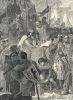
John was the son of Henry II and Eleanor of Aquitaine, and youngest brother of Richard "the Lionheart". He married twice with the first being a political move to a distant cousin Isabel of Gloucester; this was annulled. Then he married the 12 year-old Isabella of Angouleme, who gave him three daughters and two sons. He was an educated man who loved hunting and traveling. Since Henry II did not award him land as he did his older sons, John was given the name of "Lackland". The name proved to suit him as, during his reign, he lost most of the land England had acquired earlier. John's life was characterized by double-crossing tumultuous relationships: First he allied with his brother Richard to rebel against their father; later he allied with King Philip II of France to fight Richard. He then turned on Phillip, causing England to lose Normandy. And lastly, he battled with his oldest brother's son Arthur over the right to the throne, which he ultimately, after Richard's death, advanced to the throne. Many English barons and clergy thought he had poor judgment, was wicked and could not be trusted. And he was even excommunicated from the Church by Pope Innocent III. Although he did make improvements in military, taxation, and in the justice system, his faults and mistakes overshadowed any achievements. While John was in France and for the first time in history, barons made a national protest against such a bad government. On June 15, 1215, John sealed the "Magna Carta", the Great Charter, which restated the rights of the Church, the barons and all in the land. Within months, John broke all of these promises, causing the Church and the barons to summon aid from France. In the midst of the French invading England, John died of dysentery leaving his nine-year-old son to become Henry III. At this point, his widow, Isabella of Angouleme, was sent back to France without her very young children. King John may also be remembered as the rival of Robin Hood, the heroic outlaw in English folklore. His body is buried at Worcester Cathedral, and his heart at Fontevraud Abbey.
https://www.findagrave.com/memorial/91818151/john_i
- [S810] Wikipedia: Magna Carta, (Name: Wikipedia;), Magna Carta Libertatum.
Magna Carta is a royal charter[4][5] of rights agreed to by King John of England at Runnymede, near Windsor, on 15 June 1215.[b] First drafted by the Archbishop of Canterbury, Cardinal Stephen Langton, to make peace between the unpopular king and a group of rebel barons, it promised the protection of church rights, protection for the barons from illegal imprisonment, access to swift justice, and limitations on feudal payments to the Crown, to be implemented through a council of 25 barons. Neither side stood behind their commitments, and the charter was annulled by Pope Innocent III, leading to the First Barons' War.
After John's death, the regency government of his young son, Henry III, reissued the document in 1216, stripped of some of its more radical content, in an unsuccessful bid to build political support for their cause. At the end of the war in 1217, it formed part of the peace treaty agreed at Lambeth, where the document acquired the name "Magna Carta", to distinguish it from the smaller Charter of the Forest which was issued at the same time. Short of funds, Henry reissued the charter again in 1225 in exchange for a grant of new taxes. His son, Edward I, repeated the exercise in 1297, this time confirming it as part of England's statute law. The charter became part of English political life and was typically renewed by each monarch in turn, although as time went by and the fledgling Parliament of England passed new laws, it lost some of its practical significance.
At the end of the 16th century, there was an upsurge in interest in Magna Carta. Lawyers and historians at the time believed that there was an ancient English constitution, going back to the days of the Anglo-Saxons, that protected individual English freedoms. They argued that the Norman invasion of 1066 had overthrown these rights, and that Magna Carta had been a popular attempt to restore them, making the charter an essential foundation for the contemporary powers of Parliament and legal principles such as habeas corpus. Although this historical account was badly flawed, jurists such as Sir Edward Coke used Magna Carta extensively in the early 17th century, arguing against the divine right of kings. Both James I and his son Charles I attempted to suppress the discussion of Magna Carta. The political myth of Magna Carta and its protection of ancient personal liberties persisted after the Glorious Revolution of 1688 until well into the 19th century. It influenced the early American colonists in the Thirteen Colonies and the formation of the United States Constitution, which became the supreme law of the land in the new republic of the United States.[c] Research by Victorian historians showed that the original 1215 charter had concerned the medieval relationship between the monarch and the barons, rather than the rights of ordinary people, but the charter remained a powerful, iconic document, even after almost all of its content was repealed from the statute books in the 19th and 20th centuries. None of the original 1215 Magna Carta is currently in force as it was repealed, however four clauses of the original charter (1 (part), 13, 39 and 40) are enshrined in the 1297 reissued Magna Carta and do still remain in force in England and Wales (as clauses 1, 9 and 29 of the 1297 statute).[6][7]
Magna Carta still forms an important symbol of liberty today, often cited by politicians and campaigners, and is held in great respect by the British and American legal communities, Lord Denning describing it as "the greatest constitutional document of all times—the foundation of the freedom of the individual against the arbitrary authority of the despot".[8] In the 21st century, four exemplifications of the original 1215 charter remain in existence, two at the British Library, one at Lincoln Castle and one at Salisbury Cathedral. There are also a handful of the subsequent charters in public and private ownership, including copies of the 1297 charter in both the United States and Australia. Although scholars refer to the 63 numbered "clauses" of Magna Carta, this is a modern system of numbering, introduced by Sir William Blackstone in 1759; the original charter formed a single, long unbroken text. The four original 1215 charters were displayed together at the British Library for one day, 3 February 2015, to mark the 800th anniversary of Magna Carta.
https://en.wikipedia.org/wiki/Magna_Carta
 |
(Historic) Magna Carta
The Magna Carta (originally known as the Charter of Liberties) of 1215, written in iron gall ink on parchment in medieval Latin, using standard abbreviations of the period, authenticated with the Great Seal of King John. The original wax seal was lost over the centuries. -- Wikipedia: https://en.wikipedia.org/wiki/Magna_Carta |
- [S809] Wikipedia: Isabella of Angouleme, Isabella of Angoulême.
Isabella of Angoulême (French: Isabelle d'Angoulême, IPA: [izabɛl dɑ̃ɡulɛm]; c. 1186/1188 – 4 June 1246) was queen consort of England as the second wife of King John from 1200 until John's death in 1216. She was also suo jure Countess of Angoulême from 1202 until 1246.
Isabella had five children by the king, including his heir, later Henry III. In 1220, Isabella married Hugh X of Lusignan, Count of La Marche, by whom she had another nine children.
Some of Isabella's contemporaries, as well as later writers, claim that Isabella formed a conspiracy against King Louis IX of France in 1241, after being publicly snubbed by his mother, Blanche of Castile, for whom she had a deep-seated hatred. In 1244, after the plot had failed, Isabella was accused of attempting to poison the king. To avoid arrest, she sought refuge in Fontevraud Abbey, where she died two years later
https://en.wikipedia.org/wiki/Isabella_of_Angoulême
|


 1166 - 1216 (49 years)
 [2, 3]