| Sources |
- [S54] Ancestry Family Trees, (Name: Online publication - Provo, UT : Ancestry.com. Original data: Family Tree files submitted by Ancestry members.;), Database online.
- [S10709] FindAGrave Old World (Famous), Henri I 1008-1060 - King of France.
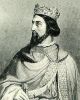
Henri Capet I - French Monarch. He was the son of King Robert II and grandson of Hugh Capet, the founder and first king of the Capetian dynasty (although Hugh's paternal grandfather, Robert I, had served briefly as King of West Francia from 922 until his death in 923). Henri became the heir to his father's throne upon the death of his elder brother, Hugh, in 1025. Following a tradition of the early Capetians to ensure the succession to the throne, he was crowned co-King of France on May 14, 1027, during the lifetime of his father, although he exercised no real monarchial power until his father's death on July 20, 1031. He and his younger brother, Robert, engaged in open revolt against their father, with the encouragement of their mother, and forced him to seek shelter in Paris. Peace was subsequently restored and was to last until their father's death. Historians in the past have largely assessed Henri as a weak monarch under whose reign the French royal domain reached its smallest size, but this assessment has been revisited and reinterpreted in light of the considerable limitations of the French monarchy during this period. He successfully suppressed the rebellion of his younger brother, Robert, who rebelled with the connivance of their mother, the dowager Queen Constance, with Robert being granted the duchy of Burgundy in 1032. King Henri came into conflict with Holy Roman Emperor Henry III over the county of Blois and although initially supportive of William, Duke of Normandy (later to reign as William I, the Conqueror, King of England), he increasingly came into conflict with the Normans. He died on August 4, 1060 while besieging Norman occupied Thimert. He was succeeded by Philip I, his eldest son by his second wife, Anne of Kiev.
https://www.findagrave.com/memorial/21076/henri_i
- [S326] Wikipedia: Henry I of France, Henri Capet I.
Henry I (4 May 1008 – 4 August 1060) was King of the Franks from 1031 to 1060, the third from the House of Capet. The royal demesne of France reached its smallest size during his reign, and for this reason he is often seen as emblematic of the weakness of the early Capetians. This is not entirely agreed upon, however, as other historians regard him as a strong but realistic king, who was forced to conduct a policy mindful of the limitations of the French monarchy.
https://en.wikipedia.org/wiki/Henry_I_of_France
- [S328] Wikipedia: Robert II of France, Robert Capet II.
Robert II (c. 972 – 20 July 1031), called the Pious (French: le Pieux) or the Wise (French: le Sage), was King of the Franks from 996 to 1031, the second from the Capetian dynasty. Crowned Junior King in 987, he assisted his father on military matters (notably during the two sieges of Laon, in 988 and 991). His solid education, provided by Gerbert of Aurillac (the future Pope Sylvester II) in Reims, allowed him to deal with religious questions of which he quickly became the guarantor (he headed the Council of Saint-Basle de Verzy in 991 and that of Chelles in 994). Continuing the political work of his father, after becoming sole ruler in 996, he managed to maintain the alliance with the Duchy of Normandy and the County of Anjou and thus was able to contain the ambitions of Count Odo II of Blois.
Robert II distinguished himself with an extraordinarily long reign for the time. His 35-year-long reign was marked by his attempts to expand the royal domain by any means, especially by his long struggle to gain the Duchy of Burgundy (which ended in 1014 with his victory) after the death in 1002 without male descendants of his paternal uncle Duke Henry I, after a war against Otto-William of Ivrea, Henry I's stepson and adopted by him as his heir. His policies earned him many enemies, including three of his sons.
The marital setbacks of Robert II (he married three times, having two of these annulled and attempting to have the third annulled, prevented only by the Pope's refusal to agree to a third annulment), strangely contrasted with the pious aura, bordering on holiness, which his biographer Helgaud of Fleury was willing to lend him in his work "Life of King Robert the Pious" (Epitoma vitæ regis Roberti pii). His life was then presented as a model to follow, made of innumerable pious donations to various religious establishments, of charity towards the poor and, above all, of gestures considered sacred, such as the healing of certain lepers. Robert II was the first sovereign considered to be a "miracle worker". The end of his reign revealed the relative weakness of the sovereign, who had to face the revolt of his third wife Constance and then of his own sons (Henri and Robert) between 1025 and 1031.
https://en.wikipedia.org/wiki/Robert_II_of_France
- [S325] Wikipedia: Anne of Kiev, Anna Agnesa Yaroslavna.
Anne of Kiev (c. 1030 – 1075), Anna Yaroslavna, Anna of Rus also called Agnes, in France known initially as Anne de Russie[1] or Agnes de Russie,[2] was the queen consort of Henry I of France, and regent of France during the minority of her son, Philip I of France, from 1060 until 1065.
Anne founded St. Vincent Abbey in Senlis.
https://en.wikipedia.org/wiki/Anne_of_Kiev
|


 1008 - 1060 (52 years)
 [1, 2, 3]